
Views: 0 Author: Site Editor Publish Time: 2026-03-13 Origin: Site


Ever touched metal and felt a sudden shock? That small spark comes from Static Electricity.Static Electricity builds when charges gather on surfaces. It may damage electronics or attract dust.
In this article, you will learn how Static Electricity forms and how to remove it safely using practical Static elimination methods.
Static Electricity is the imbalance of positive and negative electrical charges on a surface. Unlike current electricity that moves through wires, static charges remain in one place until they find a path to discharge. This usually happens when a charged object contacts a conductor such as metal or the human body.
Several conditions make Static Electricity easier to build up:
● Insulating materials
Materials like plastics, synthetic fabrics, and rubber do not allow electrons to move easily. Because of this, electrical charges accumulate on the surface instead of dissipating.
● Repeated contact and separation
Every time two materials interact and separate, a small amount of charge transfers. Over time, these transfers create noticeable static buildup.
● Low humidity environments
Dry air reduces the conductivity of surfaces. Without moisture in the air, electrical charges remain trapped longer and Static Electricity becomes stronger.
When static charges accumulate, they create an electrostatic field around the object. This field can attract particles such as dust or fibers, which is why charged surfaces often collect contaminants.
The triboelectric effect explains how Static Electricity forms during friction or contact between materials. When two different materials rub against each other, electrons move from one surface to the other. After separation, both materials carry opposite charges.
Many everyday situations create this effect:
● Walking across carpet while wearing socks
● Removing clothes from a dryer
● Sliding across plastic seating surfaces
● Handling plastic packaging materials
These actions cause friction and material separation, which increases electron transfer. In industrial environments, conveyor belts, rollers, and plastic films often generate Static Electricity through the same mechanism.
Situation | Why Static Electricity Occurs |
Walking on carpet | Friction between shoes and carpet transfers electrons |
Removing clothes from dryer | Synthetic fabrics rub together during tumbling |
Plastic film processing | Continuous contact and separation during production |
Sliding on plastic seats | Material friction creates charge imbalance |
Because many modern materials are synthetic and insulating, they hold electrical charges easily. When humidity is low or friction is frequent, Static Electricity becomes more noticeable and harder to control.
One of the most serious effects of Static Electricity is electrostatic discharge (ESD). When a charged object touches an electronic device, the stored charge moves instantly through the circuit. The voltage may appear small to humans. For microchips, it can be destructive.
Electronic components operate at very low voltages. Even a minor electrostatic discharge can damage internal structures inside integrated circuits or sensors. This damage sometimes happens instantly. Other times it weakens the device and causes later failures.
Common problems caused by ESD include:
● Component failure
Microchips and semiconductors contain extremely delicate internal structures. When Static Electricity discharges into them, the sudden voltage surge can burn microscopic pathways inside the chip. Even if the device continues to function, its lifespan may be shortened significantly.
● System malfunction
Industrial control boards, communication modules, and sensor systems rely on stable electrical signals. Static discharge can disturb these signals and lead to system errors or unexpected shutdowns during operation.
● Hidden damage
Some electrostatic events do not destroy components immediately. Instead, they weaken internal circuits. Over time, this hidden damage causes unpredictable failures in electronic products.
In electronics manufacturing environments, companies often install ionizing equipment and electrostatic monitoring systems to reduce these risks. They help maintain stable electrostatic conditions during assembly and inspection processes.
Another major problem caused by Static Electricity is particle attraction. When a surface becomes electrically charged, it creates an electrostatic field around it. This field pulls small airborne particles toward the surface.
These particles may include:
● dust
● fibers
● plastic debris
● microscopic contaminants
Once they attach to the surface, they become difficult to remove. In industries such as electronics, optics, printing, or coating, this contamination can reduce product quality.
Manufacturing Surface | Static Electricity Effect | Resulting Issue |
Plastic film | Surface charge attracts dust | Surface defects |
Electronic circuit boards | Charged components pull particles | Assembly contamination |
Coated materials | Dust attaches during coating | Finish imperfections |
Packaging materials | Static pulls fibers and debris | Product cleanliness issues |
In precision manufacturing environments, even tiny contaminants can cause defects. For this reason, many production lines use ionization equipment or electrostatic sensors to reduce charge buildup before it attracts particles.
Static Electricity also interferes directly with automated manufacturing systems. When materials become charged, they no longer behave normally. Instead of moving smoothly through machines, they may stick together or repel each other.
These problems often appear in industries handling lightweight or flexible materials.
Typical examples include:
● Material sticking
Plastic films, paper sheets, or labels sometimes cling to each other because of electrostatic attraction. When this happens, automated feeders may pick up multiple sheets at once or fail to separate them properly.
● Material repelling
Two surfaces carrying similar charges repel each other. This can cause sheets to lift or drift away from conveyor belts. It disrupts alignment during printing, laminating, or cutting processes.
● Machine feeding errors
Static charges on conveyor belts or rollers may affect material movement. Sheets may misfeed, fold incorrectly, or jam inside machines.
These issues slow down production and increase rejection rates. Many factories introduce ion bars or ion fans along conveyor systems to neutralize Static Electricity before it causes operational problems.
In certain environments, Static Electricity can create safety hazards. When electrical charges accumulate and discharge suddenly, they produce sparks. In areas containing flammable gases, solvents, or fine dust, these sparks can ignite dangerous reactions.
Workers may also experience frequent electrostatic shocks when touching equipment or materials. While these shocks are usually minor, repeated exposure can cause discomfort and distract workers during tasks requiring precision.
Common industrial safety concerns related to Static Electricity include:
● Spark ignition risks
In chemical processing plants or fuel storage areas, electrostatic sparks can ignite flammable vapors. Proper grounding and ionization systems are often required to prevent this hazard.
● Dust explosion risks
In industries handling powders or grains, airborne dust may become combustible. A static discharge in such environments can trigger an explosion under certain conditions.
● Worker discomfort and safety concerns
Repeated static shocks may cause workers to drop tools or react suddenly. In sensitive production environments, this can lead to accidents or product damage.
Grounding is the simplest way to remove Static Electricity. It works by providing a path for electrical charges to travel safely into the earth. When a conductive object connects to ground, excess electrons move away and the surface returns to electrical balance.
Grounding is widely used in electronics production and maintenance areas.
Common grounding practices include:
● Grounding wrist straps
Workers wear these straps when handling circuit boards or microchips. The strap connects the body to ground through a resistor. Static charges slowly drain away instead of discharging suddenly into components.
● Grounded workstations
Electronics assembly tables often include conductive mats connected to a grounding point. Tools, equipment, and materials remain at the same electrical potential.
● Conductive flooring systems
Anti-static flooring and footwear allow charges to flow through the floor instead of accumulating on workers or equipment.
These grounding methods help control Static Electricity in environments where electronic components are sensitive to electrostatic discharge.
Humidity strongly influences Static Electricity. Dry air prevents electrical charges from dissipating. When moisture increases, water molecules help conduct small amounts of electricity across surfaces. This allows charges to fade instead of building up.
Most environments experience stronger static when humidity drops below 30%. Maintaining indoor humidity between 40–60% helps stabilize electrostatic conditions.
Ways to manage humidity include:
● Using humidifiers during dry seasons
● Adjusting building HVAC systems
● Adding plants to improve indoor moisture balance
Factories that process plastic films or paper often control humidity carefully. Stable moisture levels help prevent Static Electricity from accumulating on moving materials.
Anti-static materials help prevent Static Electricity from forming on surfaces. These materials either conduct small electrical charges or reduce friction between surfaces. They are widely used in electronics packaging and industrial environments.
Typical anti-static solutions include:
● Anti-static sprays
They coat surfaces and reduce charge buildup on furniture, carpets, and equipment.
● Anti-static mats
These mats protect workstations by allowing charges to dissipate safely.
● Anti-static packaging materials
Bags, foam inserts, and containers protect electronic components during shipping or storage.
Anti-Static Material | Purpose | Typical Use |
Anti-static spray | Reduce surface charge | Carpets, equipment |
Anti-static mats | Dissipate electrical charges | Electronics workstations |
Anti-static bags | Protect sensitive devices | Component packaging |
These materials help reduce electrostatic discharge when handling sensitive products.
Ion neutralization removes Static Electricity quickly without physical contact. Ionizing devices produce both positive and negative ions. These ions move toward charged surfaces and neutralize the electrical imbalance.
Ionization equipment is common in modern manufacturing lines because it works well on insulating materials.
Typical devices include:
● Ion fans
They distribute ionized airflow across workstations and assembly areas.
● Ionizing bars
Installed above conveyors, they neutralize Static Electricity on moving films, paper, or packaging materials.
● Ion nozzles
They combine compressed air and ionization to remove static charges and dust from small areas.
Ionizing bars and rods are common solutions for controlling Static Electricity on moving materials. These devices generate balanced positive and negative ions through high-voltage ionization. When charged materials pass nearby, ions attach to the surface and neutralize the charge.
They are typically installed above conveyors, rollers, or slitting machines. As materials move through the line, the ion stream removes static continuously.
Key advantages include:
● Continuous neutralization
Ionizing bars operate during the entire production process. Moving materials stay electrically balanced. This reduces dust attraction and improves product surface quality.
● Wide coverage area
Bars can extend across long conveyor systems. They protect large material surfaces such as plastic film, packaging sheets, or textile rolls.
● Easy integration
Many production machines allow direct installation above the working area. Static control becomes automatic once the system starts.
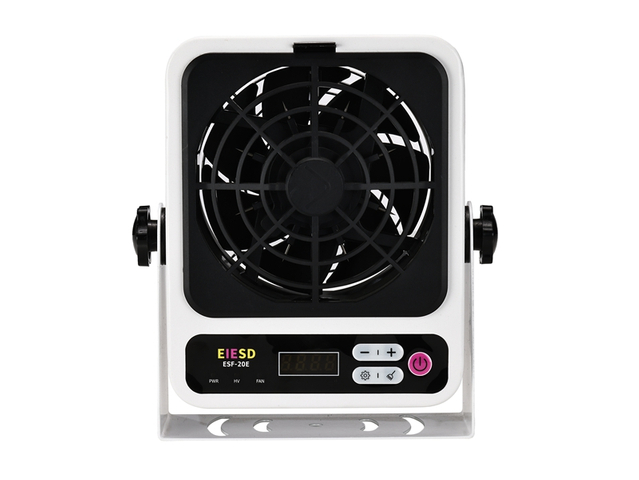
Ion fans and ion blowers control Static Electricity in open workspaces. These devices release ionized airflow across a wide area. The ions attach to charged surfaces and neutralize the electrical imbalance.
Workstations in electronics manufacturing often use ion fans. Workers move frequently. Materials contact tools and benches. Static charges build up easily during these actions.
Ion fans help solve this problem in several ways:
● Wide area airflow
Ionized air spreads across desks or assembly stations. Static charges disappear before they damage components.
● Fast response
Airflow moves ions quickly to charged surfaces. Static Electricity levels drop within seconds.
● Flexible installation
Fans may sit on desks or mount above workstations. This allows quick adjustment for different production tasks.
Ion nozzles and ion guns are designed for precise Static Electricity removal. They combine compressed air and ionization technology. The air stream carries ions toward a specific target area.
Operators often use them when static appears in small or complex spaces. For example, inside machines or around delicate electronic parts.
Typical applications include:
● removing static from circuit boards during inspection
● cleaning lenses or optical devices
● neutralizing charges inside narrow machine parts
Because they focus airflow on a single location, ion nozzles provide efficient static control in confined environments.
Electrostatic sensors help engineers detect Static Electricity levels during production. Instead of removing charge directly, they measure the electrostatic field around materials. This allows technicians to identify static problems early.
Most sensors work without touching the surface. They measure voltage differences from a short distance. When charge levels increase, operators can adjust ionization equipment or environmental conditions.
Industrial Static Control Device | Main Role in Static Electricity Control |
Ionizing bars / rods | Neutralize charges on moving materials |
Ion fans / blowers | Remove static across workstations |
Ion nozzles / guns | Eliminate localized static charges |
Electrostatic sensors | Monitor electrostatic voltage levels |
Static Electricity forms from charge imbalance and friction between materials.Proper control methods reduce shocks, contamination, and equipment failure risks.Grounding, humidity control, and ionization help neutralize surface charges quickly.Industrial devices improve production stability and product quality in many fields.GD Decent provides advanced static elimination equipment and reliable solutions.
A: Static Electricity Adsorption occurs when charged surfaces attract dust particles.
A: Static Electricity can be neutralized using grounding, humidity control, or ionizers.
A: Low humidity prevents charges from dissipating, increasing Static Electricity buildup.
A: Ion bars and ion fans neutralize Static Electricity Adsorption during manufacturing.
A: Yes, Static Electricity may damage sensitive circuits through electrostatic discharge.
