
Views: 0 Author: Site Editor Publish Time: 2026-09-11 Origin: Site


In precision manufacturing, electronics assembly, and cleanroom environments, unmitigated static electricity drives up defect rates. It attracts particulate contamination and creates operator safety hazards that threaten compliance with strict ESD standards like ANSI/ESD S20.20. While point-of-use static elimination is required, engineering and procurement teams must choose the correct delivery method. Selecting the wrong form factor leads to ergonomic bottlenecks, excessive compressed air waste, particle shedding, or inadequate static decay times on automated lines. Evaluating the technical and operational differences between fixed and handheld static elimination tools is necessary for facility optimization. This guide breaks down the engineering specifications, workflow integration requirements, and operational efficiencies to help you make an evidence-based procurement decision when comparing an ionizing air nozzle vs air gun. We will examine exact field applications, hardware limitations, and integration protocols.
Automation vs. Manual Control: The primary differentiator is workflow integration; an ionizing air nozzle is engineered for fixed, high-speed automated lines, while air guns are designed for manual, operator-driven tasks.
Precision and Footprint: An ionizing air nozzle offers a highly compact footprint for tight machine enclosures, delivering a continuous, targeted ionized airflow with options for Facility Monitoring System (FMS) integration.
Ergonomics and Compliance: Ionizing air guns must be evaluated on weight, trigger actuation force, and OSHA-compliant dead-end pressure limits to ensure operator safety during prolonged use.
Infrastructure and Cleanroom Requirements: Both solutions require clean, dry compressed air (or nitrogen) and routing for high-voltage power supplies. Emitter material selection and ISO-class compatibility are critical for contamination-sensitive environments.
Table of Contents
Static electricity on the factory floor directly impacts product yield and hardware reliability. When non-conductive materials generate triboelectric charges through friction or separation, they create an electrostatic field. This field attracts airborne particulates, causing contamination defects in surface mount technology (SMT) processes, semiconductor fabrication, and precision optics manufacturing. Establishing baseline requirements for static elimination is the first step in designing an effective control strategy.
Effective static control requires measurable performance metrics. Facility engineers define success through two primary parameters: static decay time and ion balance, also known as offset voltage. A standard requirement in sensitive electronics manufacturing is achieving a static decay time from 1000V to 100V in under two seconds. The ionizer must maintain a tight offset voltage, often within ±10V to ±35V, depending on the sensitivity of the components handled. Meeting these metrics ensures compliance with global standards such as ANSI/ESD S20.20 or IEC 61340-5-1. These standards mandate strict environmental controls to prevent electrostatic discharge (ESD) damage to sensitive components.
ESD Standard | Target Application | Typical Decay Requirement (1000V to 100V) | Allowable Offset Voltage |
|---|---|---|---|
ANSI/ESD S20.20 | General Electronics Assembly | < 2.0 Seconds | < ±35 Volts |
IEC 61340-5-1 | European Electronics Manufacturing | < 2.0 Seconds | < ±35 Volts |
SEMI E78 | Semiconductor Fabrication | < 1.0 Second | < ±10 Volts |
Class 0 / Ultra-Sensitive | MR Heads, Bare Die Handling | < 0.5 Seconds | < ±5 Volts |
In point-of-use ionization, compressed air serves a dual purpose. It acts as the high-velocity carrier medium for both positive and negative ions generated by the emitter pins. It also provides the kinetic energy necessary to break the aerodynamic boundary layer on the surface of the target object. When particulates are bound to a surface by electrostatic forces, simply blowing air over them is insufficient. The ionized air neutralizes the static charge holding the particle in place, while the physical force of the compressed air simultaneously dislodges and removes the contaminant.
Many facilities rely on ambient room ionization, such as overhead blowers, to manage static. While effective for general workspace neutralization, overhead blowers lack the targeted velocity required for complex geometries, deep crevices, or high-speed moving webs. Ambient ions recombine rapidly over distance. The concentration of active ions reaching a specific, shielded component is often too low to achieve rapid decay times. This limitation necessitates targeted delivery tools that bring the corona discharge source as close to the target as possible, ensuring maximum ion density and mechanical cleaning force exactly where it is needed.
An Ionizing Air Nozzle is engineered for permanent or semi-permanent installation within automated machinery. It provides a continuous or sensor-actuated stream of ionized air directly onto a specific target zone, operating without human intervention.
The architecture of a fixed-mount nozzle prioritizes a minimal physical footprint and maximum reliability. These devices feature a compact, cylindrical, or block-style housing containing a high-voltage emitter pin positioned precisely within the airflow path. Because they are integrated into automated systems, they are frequently paired with photoelectric sensors, proximity switches, or programmable logic controllers (PLCs). This allows the nozzle to actuate only when a part is present, conserving compressed air while maintaining high-throughput efficiency.
Fixed nozzles deliver high-velocity, pinpoint airflow designed for localized static neutralization. Their compact form factors allow them to be mounted inside robotic arms, packaging machinery, and tight chassis where space is at a premium. Advanced models utilize High-Frequency AC (HFAC) or Pulsed DC technology. HFAC systems generate a highly dense cloud of ions, making them exceptionally effective for rapid decay in high-speed applications where parts are only exposed to the ionized airflow for fractions of a second.
Ionization Technology | Mechanism | Best Application |
|---|---|---|
Standard AC (50/60 Hz) | Alternates positive and negative ions at line frequency. | General industrial webs, slower moving parts. |
High-Frequency AC (HFAC) | Alternates at high frequencies (e.g., 68 kHz) for dense ion output. | High-speed SMT lines, rapid part ejection. |
Pulsed DC | Alternates dedicated positive and negative emitters. | Long-distance neutralization, cleanroom environments. |
Automated electronics manufacturing, specifically inside pick-and-place machines on SMT lines.
High-speed labeling, printing, and packaging webs where static causes material jamming or misregistration.
Injection molding part ejection stations to prevent molded plastics from clinging to the mold or conveyor.
Automated optical inspection (AOI) equipment, ensuring parts are free of dust before camera scanning.
Vibratory bowl feeders where static causes small components to clump together.
Identify the exact point of static generation or particulate attraction on the automated line.
Mount the nozzle bracket securely, ensuring the emitter is positioned 2 to 6 inches from the target surface.
Route the clean, dry compressed air line (ISO 8573-1 compliant) to the nozzle inlet, installing a point-of-use coalescing filter.
Connect the high-voltage power supply, ensuring cables are shielded from moving mechanical parts and data lines.
Integrate a photoelectric sensor and solenoid valve via the machine's PLC to trigger airflow only when a part enters the target zone.
Verify static decay times and offset voltage using a charged plate monitor before initiating full production.
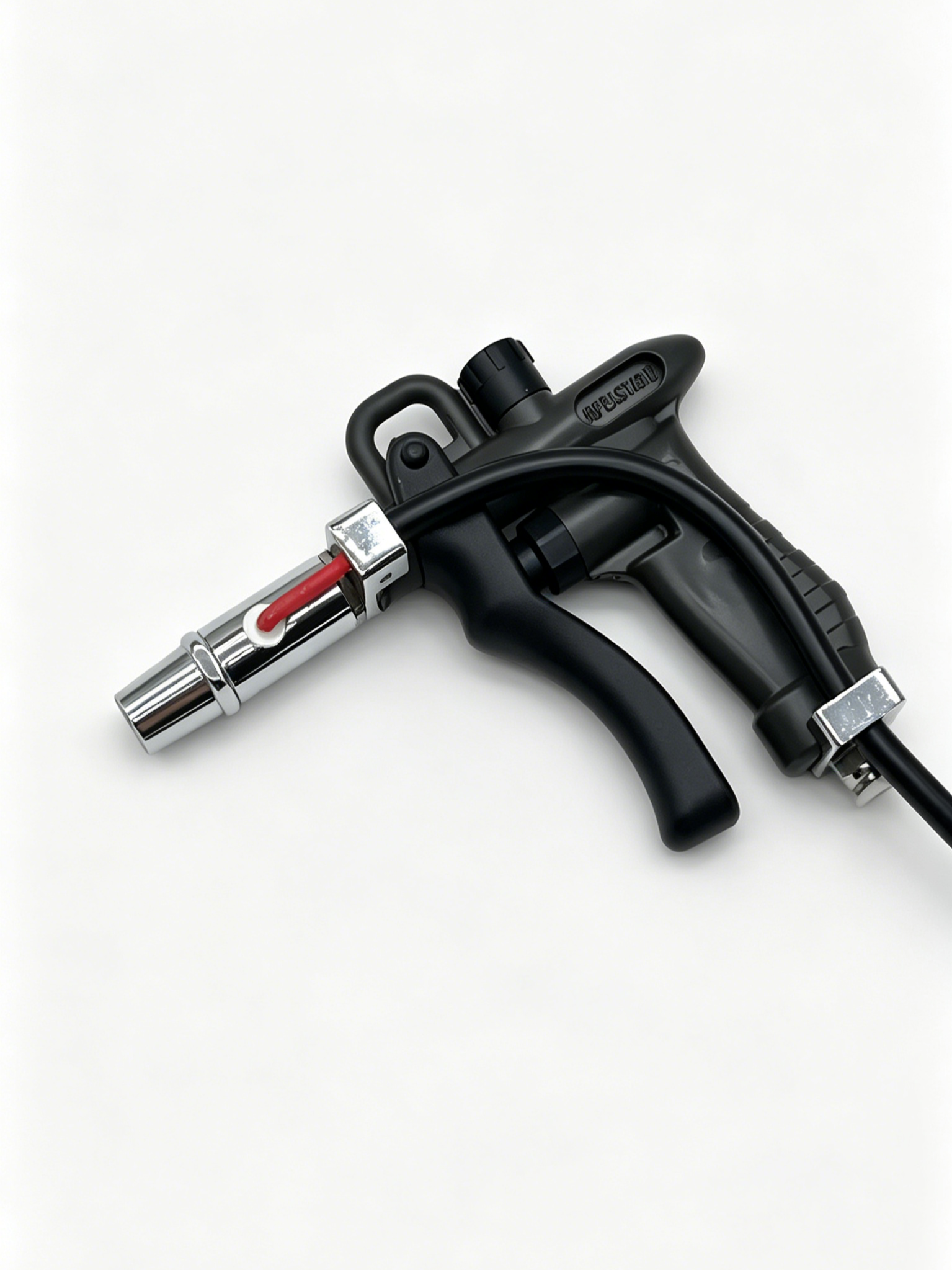
Handheld ionization tools are built for flexibility, mobility, and operator-driven tasks. They combine the static-neutralizing power of a fixed nozzle with the ergonomic control of a traditional industrial blow-off gun.
The handheld, pistol-grip form factor is the defining characteristic of this category. These devices feature manual trigger mechanisms that allow operators to control the timing and duration of the ionized airflow. The architecture includes ruggedized housings designed to withstand drops and impacts common in industrial environments. Flexible cable and hose management systems route both the compressed air and the high-voltage power supply from a base unit to the handpiece, requiring careful engineering to prevent fatigue and cable degradation over time.
Handheld units offer variable airflow control directly linked to operator trigger actuation. They utilize wider nozzle orifices or interchangeable tips to provide broader blow-off coverage, accommodating varying part sizes and working distances. For stringently controlled environments, many models are compatible with nitrogen gas instead of standard compressed air. Utilizing nitrogen prevents oxidation on sensitive surfaces, such as bare silicon wafers or specialized optical coatings, while still delivering the necessary ion stream.
Manual prep-to-paint stations in automotive manufacturing to ensure panels are entirely free of dust before coating.
Electronics rework, inspection, and manual assembly benches where operators handle individual circuit boards.
Medical device cleanroom packaging, where operators assist in sealing sterile components.
Optics and semiconductor manual wipe-down stations requiring precision dust removal.
Selecting the appropriate equipment requires a granular comparison across several engineering and operational dimensions. The following table summarizes the primary technical distinctions.

Evaluation Dimension | Fixed Nozzle | Handheld Gun |
|---|---|---|
Workflow Integration | Automated, PLC-driven, hands-free operation. | Manual, operator-dependent trigger actuation. |
Target Distance | Fixed and optimized (typically 2 to 6 inches). | Variable, dependent on operator handling. |
Air Consumption | High if continuous; optimized via solenoid valves. | Inherently intermittent based on trigger use. |
Ergonomic Risk | Zero operator fatigue. | Requires evaluation of trigger force and weight. |
System Monitoring | Often integrates with FMS for automated alerts. | Relies on visual indicators on the power supply. |
Fixed nozzles excel in fully automated environments. They require initial setup involving PLC integration, photoelectric sensors, and precise mechanical mounting. Once installed, they operate with zero operator fatigue and can be daisy-chained for synchronized operation across a wide manufacturing web. Handheld guns require manual intervention. They provide high flexibility for complex, multi-sided parts that cannot be easily automated, allowing an operator to visually inspect and manually direct the ionized air into blind holes or intricate geometries.
Because fixed nozzles are hard-mounted, they are optimized for fixed distances, operating between 2 to 6 inches from the target surface. This fixed distance guarantees consistent, repeatable decay times and allows engineers to utilize laminar flow options for highly controlled environments. Handheld guns are effective over variable distances, but this introduces operator dependency. If an operator holds the gun too far from the target, ion recombination increases, which introduces inconsistencies in ion balance and overall decay performance.
In ISO Class 1-5 environments, contamination control is paramount. Fixed nozzles are available in ultra-clean materials, utilizing monocrystalline silicon or titanium emitters to prevent the tungsten particle shedding common in standard ionizers. Handheld guns must be specifically rated for cleanrooms. Standard industrial guns introduce particulates into the environment via mechanical friction within the trigger valve or through non-compliant, outgassing casing materials.
Compressed air is one of the most expensive utilities in a manufacturing plant. Fixed nozzles consume significant volumes of air if allowed to run continuously. To control energy usage, they require the installation of solenoid valves for intermittent, part-present actuation. Handheld guns are inherently intermittent due to their trigger-based operation. This results in lower overall air consumption per shift compared to continuously running fixed nozzles, though operator misuse can negate this advantage.
Safety considerations differ vastly between the two formats. Fixed nozzles are hands-free, meaning the primary safety concern is acoustic noise levels (dBA) generated at the machine level, which must be kept below facility thresholds. Handheld guns introduce direct operator interaction. They must meet OSHA standard 1910.242(b), which mandates dead-end pressure relief to prevent air from penetrating the skin if the nozzle is blocked. Safety evaluations must include repetitive strain injury (RSI) risks related to trigger pull force, grip design, and the overall weight of the handpiece and cable assembly.
In modern Industry 4.0 facilities, data collection is required. Fixed nozzles are equipped with visual LED indicators and Facility Monitoring System (FMS) outputs. These outputs alert PLCs immediately if an ion balance failure occurs or if the emitter pins require cleaning, preventing the production of defective parts. Handheld guns rely on visual indicators located on the remote power supply unit. They are less likely to be integrated into centralized facility monitoring software, placing the burden of verification on the operator or routine maintenance schedules.
Beyond the immediate technical specifications, facility managers must evaluate the long-term operational impact of their chosen static elimination strategy. This involves analyzing maintenance workflows, equipment durability, and the scalability of the installation.
All corona discharge ionizers require regular maintenance. As high voltage is applied to the emitter pin, it naturally attracts airborne trace elements, leading to silicon dioxide buildup on the tip. This buildup insulates the pin, reducing ion output and skewing the ion balance. Both fixed and handheld units require regular cleaning of these pins using specialized swabs and isopropyl alcohol. Handheld guns suffer significantly higher physical wear and tear. Drops onto concrete floors, cable fraying from continuous movement, and trigger valve degradation lead to more frequent hardware replacement compared to stationary, protected fixed nozzles.
Scalability is a primary factor when designing a production line. Fixed nozzles offer superior modularity. Many modern systems allow engineers to daisy-chain multiple ionizing air nozzles to a single high-voltage power supply or controller. This reduces clutter, simplifies wiring, and centralizes control. Handheld ionizing air gun power units face 1:1 or 1:2 limitations, meaning each operator station requires its own dedicated power supply, consuming valuable bench space and requiring individual power drops.
Deploying static elimination equipment introduces specific facility risks that must be managed during the installation and operational phases. Proactive mitigation ensures consistent performance and protects sensitive product yields.
The most common cause of premature ionizer failure is poor compressed air quality. The risk involves oil, water, or particulate contamination in the air supply bridging the gap between the high-voltage emitter and the ground reference, causing a short circuit or erratic ion balance. Facilities must mandate the installation of point-of-use coalescing filters immediately upstream of the ionizer. Ensuring the air supply complies with ISO 8573-1 standards for clean, dry air is non-negotiable. In ultra-sensitive applications, utilizing bottled or generated nitrogen eliminates moisture and compressor oil risks entirely.
Routing high-voltage cables through automated machinery or across manual workstations presents risks of electromagnetic interference (EMI) with nearby sensitive electronics, as well as physical cable degradation over time. Implement proper shielding protocols and maintain physical separation from data cables. Where applicable, utilize low-voltage (24V DC) models that feature internal miniature high-voltage power supplies directly inside the nozzle or gun housing. For handheld units, implementing robust strain relief balancers prevents operators from dragging or sharply bending the cables.
A significant risk in static control is the silent failure. If an ionizer loses high voltage but continues to blow compressed air, operators may falsely believe the area is being neutralized, leading to catastrophic ESD damage. Implement a rigorous, documented auditing schedule. Use charged plate monitors (CPM) or electrostatic field meters to verify static decay times and offset voltages regularly. Do not rely solely on the device's internal LED indicators; independent verification ensures ongoing compliance with ANSI/ESD S20.20 requirements.
Symptom | Potential Cause | Field Troubleshooting Action |
|---|---|---|
Slow Static Decay Time | Silicon dioxide buildup on emitter pin. | Power down unit. Clean emitter pin with isopropyl alcohol swab. |
High Offset Voltage (Imbalance) | Degraded emitter pin or failing power supply. | Inspect pin for physical pitting. Replace pin or test power supply output. |
No Airflow | Blocked inline filter or failed solenoid valve. | Check point-of-use coalescing filter. Verify PLC signal to solenoid. |
Intermittent Power | Cable fatigue or loose high-voltage connection. | Inspect cable routing for sharp bends. Reseat all high-voltage connectors. |
Conduct a comprehensive compressed air audit to verify point-of-use filtration meets ISO 8573-1 standards before connecting any ionization equipment.
Calculate required static decay times based on the speed of your automated line or the sensitivity of the components handled manually.
Request a pilot unit from your supplier to perform in-situ testing with a charged plate monitor in your actual production environment.
Establish a documented maintenance schedule for emitter pin cleaning and calibration verification to prevent silent failures.
A: The primary difference is workflow integration. An ionizing air nozzle is a fixed-mount device designed for automated, hands-free operations and continuous production lines. An ionizing air gun is a handheld, trigger-operated device designed for manual, operator-driven tasks requiring flexibility and variable targeting.
A: Consumption varies based on operating pressure and orifice size, typically ranging from 2 to 10 standard cubic feet per minute (SCFM) at 30 to 60 PSI. To minimize air usage, fixed nozzles should be paired with photoelectric sensors and solenoid valves so they only blow air when a part is present.
A: Yes, but it must be specifically designed for cleanroom use. Standard industrial guns shed particulates from trigger friction or tungsten emitters. Cleanroom-rated guns utilize specialized casing materials, monocrystalline silicon emitters, and sealed valves to meet ISO Class 1-5 requirements.
A: Yes. Many high-precision nozzles and guns are fully compatible with nitrogen. Using nitrogen is recommended in semiconductor and optical manufacturing because it prevents the oxidation of sensitive surfaces that occurs when standard compressed air is used.
A: Emitter pins should be cleaned every 1 to 4 weeks using a specialized swab and isopropyl alcohol to remove silicon dioxide buildup. Replacement frequency depends on usage and air quality, but pins generally last between 1 to 3 years before physical degradation affects ion balance.
A: Reputable industrial ionizing air guns are designed to comply with OSHA standard 1910.242(b). This standard requires that if the tip of the gun is dead-ended by a hand or body part, the static pressure at the point of blockage must relieve itself to below 30 PSI to prevent air embolism.
