
Views: 0 Author: Site Editor Publish Time: 2025-12-10 Origin: Site


Feature | AC Fans | DC Fans |
|---|---|---|
Noise Level Reduction | N/A | Up to 50% |
Energy Efficiency | N/A | 30–40% |
Lifespan Improvement | N/A | Significant due to brushless motors |
Choosing the right fan requires understanding how these features impact your needs.
AC fans run on alternating current. They give steady airflow. This makes them good for big rooms.
DC fans use direct current. They are quieter than AC fans. They use less energy. This helps you save money over time.
Pick AC fans for fast static removal in busy places. Choose DC fans for quiet and energy-saving spaces.
DC fans let you control speed and settings better. This makes them great for smart homes.
Think about what you need, like airflow and noise. This will help you pick between AC and DC fans.
AC ionizers use alternating current to work. The AC power gives energy to the fan and ionizing parts. Most industrial models use voltages like 110V or 220V. The AC power needs to stay steady for the fan to last longer. If the power changes a lot, the motor can get too hot and break down faster. Power interruptions can make the fan stop and start suddenly. This can also make the fan wear out sooner. You can help your fan by using surge protectors and voltage regulators. These tools keep the electricity steady. This means you will need less repairs and your fan will last longer.
Here is a table showing voltage and current for common AC ionizing fans:
Model | Power Supply Voltage | Current Consumption |
|---|---|---|
ZJ-FA20 Ionizer | 24 VDC | 900 mA max |
AP-DJ2712 Ion Fan | DC 24V / 220VAC | < 0.15A AC |
IONMASTER Model 6214 | 110 V AC | 2.70 Amp (heater on); 0.2 Amp (heater off) |
ION-1000 Ionizing Air Gun | 110V/220V | Max 0.8A or 0.4A |
AC ionizers use high voltage to make ions in the air. This happens when the fan is running. The device uses electrodes to send high voltage to air molecules. The molecules split and turn into charged particles called ions. Most AC ionizers make negative ions. Negative ions have extra electrons and a negative charge.
Air ionizers use high voltage to make charged particles from air molecules.
Negative ions have extra electrons and a negative charge.
Air particles get charged by sticking to these ions.
Charged particles attach to grounded surfaces and leave the air cleaner.
AC fans often use the ionic wind method. It has two electrodes, one sharp and one flat. High voltage goes to the sharp electrode. Air molecules near it get ionized. The fan blows the ions into the room. Positive ions move from high voltage to low voltage. Negative ions move faster and work better.
Here is a table comparing how well different ionic flows work:
Ionic Flow Type | Efficiency Comparison | Key Findings |
|---|---|---|
Positive Ionic Flow | Lower velocities | Less efficient compared to negative ionic flows. |
Negative Ionic Flow | Higher velocities | More efficient, as supported by multiple studies. |
Tip: For the best air cleaning, pick a fan that makes more negative ions. Studies show negative ions clean the air faster and remove more particles.
DC ionizers use direct current to run the fan. They have two power supplies for positive and negative voltages. This helps the fan work well and keeps ion making steady. DC ionizers do not need a transformer to boost voltage. They use electronics to switch charges at a slower rate. The lower rate means fewer ions join back together. So, you get more ions in the air.
Here is a table that shows the main technical differences between AC and DC ionizers:
Feature | AC Ionizers | DC Ionizers |
|---|---|---|
Power Source | Uses a transformer to multiply AC voltage | Utilizes separate power supplies for positive and negative voltages |
Ion Generation | Produces both positive and negative ions simultaneously | Alternates between positive and negative at lower frequency |
Ion Recombination | Higher due to fast cycling (60Hz) | Reduced due to lower frequency in pulsed DC units |
Airflow Requirement | Requires high-speed airflow | Allows for reduced airflow, enhancing operator comfort |
Offset Voltage | Not specified | High offset voltage during single polarity ionization |
Continuous Operation | Not applicable | Steady-state operation with both supplies on continuously |
Ion Density | Lower due to recombination | Higher due to continuous operation of both supplies |
Note: DC ionizers can work with less airflow. This makes them more comfortable for people near the fan.
DC ionizers use pulsed DC to make ions. The fan switches between positive and negative charges. This gives you a steady flow of both ions. It helps lower static electricity and cleans the air. Studies show negative air ions from DC ionizers can remove tiny particles. These ions may also slow down some germs. More research is needed to prove health effects.
Here is a table showing how well dc ionizers remove particles of different sizes:
Particle Size (mm) | Percentage of Particles | Reduction After 60 Minutes |
|---|---|---|
0.3 - 0.5 | 85% | > 40% |
0.5 - 0.7 | 10% | N/A |
0.7 and above | 5% | N/A |
DC ionizers work best on the smallest particles. This helps make indoor air cleaner. You will see less dust and cleaner air with these fans.
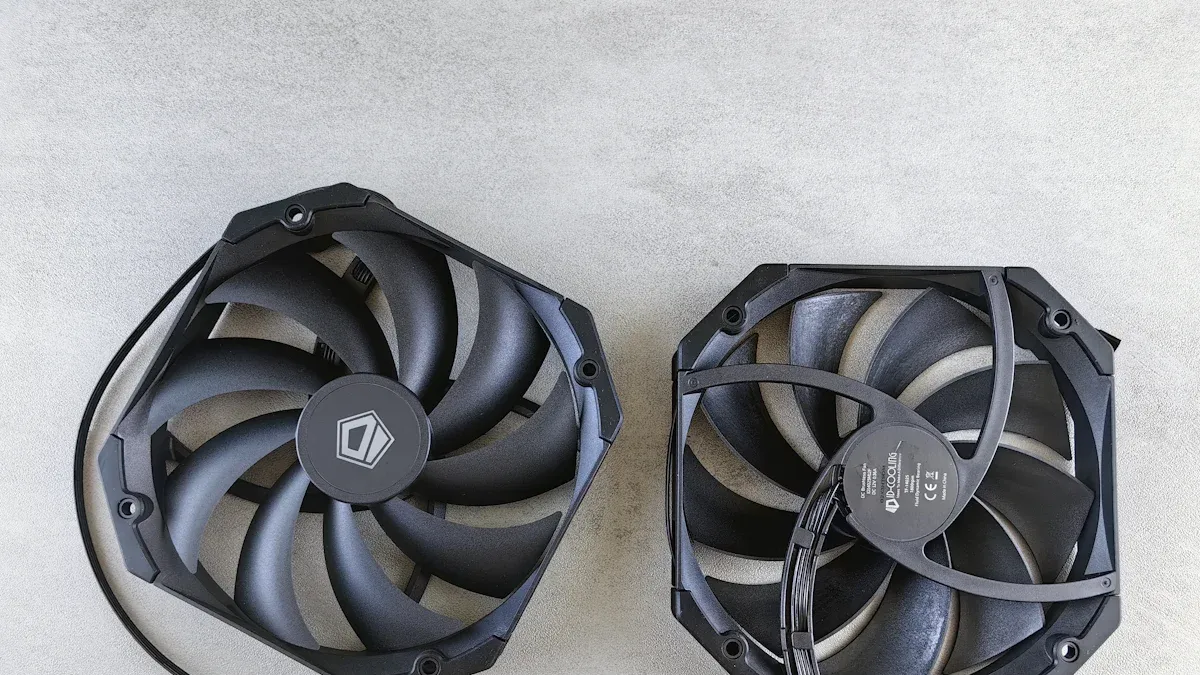
It is important to know how airflow and static elimination make ac ionizing fan and dc fans different. Airflow helps ions move around the room. AC fans blow air faster. This strong wind spreads ions quickly. You will see static electricity go away fast. DC fans use lower airflow. They give a soft breeze that feels nice. These fans still remove static, but it takes longer. DC fans use pulsed ionization. This keeps more ions in the air. Over time, you will notice less static.
Places with sensitive electronics need static gone. AC fans clear static fast in busy areas. DC fans keep static low where people work close by. You should pick a fan based on how much static you want to remove and how much airflow you like.
AC fans: Strong wind, fast static removal, good for big rooms.
DC fans: Soft wind, steady static control, best for close work.
Energy use and noise are other ways ac ionizing fan and dc fans are not the same. DC fans use less power. This saves you money on your bills. AC fans use more energy. You pay more if you run them a lot. Look at the table below to see how much energy each type uses:
Fan Type | Power Consumption (Watts) | Energy Cost Equivalent |
|---|---|---|
DC Fan | 25 | $3 |
AC Fan | 100 | $10 |
DC fans help you spend less and use less energy. This is better for the planet. New DC fans have special motors. These motors can save up to 70% more energy than old AC fans. You see this in homes and offices where people want to save power.
Noise is important if you work or sleep near fans. DC fans are quiet. You hear less buzzing or humming. AC fans are louder because of their old motor style. You notice this in places like libraries, bedrooms, and labs. DC fans help keep things peaceful.
New technology makes dc fans even better. You get smart controls, voice commands, and app features. You can set times and change speed with your phone. DC fans work well in smart homes and new offices.
Advancement Type | Description |
|---|---|
Air Purification and Ionization | Some new fans clean the air and add ions for better air quality. |
Energy Efficiency and DC Motors | DC motors save a lot of energy compared to old AC motors. |
Lower Energy Consumption | DC fans can use up to 70% less energy, which is good for the environment. |
Improved Performance | DC motors give you more speed choices for better airflow. |
Quieter Operation | DC motors are made to be quiet, great for quiet places. |
Smart Home Integration | Fans can be part of smart home systems for easy control. |
Voice and App Control | You can use your voice or phone to control modern fans. |
Automation and Personalization | Smart fans can run on schedules and change based on who is in the room. |
Voltage and how hard the fan is to build are other ways ac ionizing fan and dc fans are different. AC fans need high voltage to make ions. Their circuits are simple, using capacitors and diodes. These parts boost the voltage from the wall. For example, a voltage multiplier with 15 stages can turn 230V AC into about 6900V DC. Each stage only needs two capacitors and two diodes. This makes the design easy to build and fix.
DC fans use different power supplies for positive and negative voltages. This means more parts and harder circuits. DC fans do not need a transformer, but they use special electronics to switch charges. This helps keep ion production steady. You get more ions in the air. DC fans are better when you need strong static control.
You should also think about what can go wrong. Both ac fans and dc fans can break. Bearings break most often. This happens in 35–45% of cases. Imbalance is next, in 15–20% of fans. You should check your fans often to keep them working well.
Failure Mode | Frequency (%) |
|---|---|
Bearing failure | 35 – 45% |
Imbalance | 15 – 20% |
Misalignment | N/A |
Motor failure | N/A |
You should choose between ac fans and dc fans by looking at voltage needs and how easy they are to fix. AC fans have simple circuits and are easy to repair. DC fans have more features and better ion control.
Tip: If you want something easy to set up and fix, pick ac fans. If you want smart features and lots of ions, choose dc fans.
Factories and electronics shops use ac fans and dc fans. These places need strong air and good cooling. Ac fans give steady air and can do hard work. You use ac fans to cool machines and protect electronics from static. Many ac fans last a long time if you care for them. The table below shows why these fans are good for factories:
Benefit/Feature | Description |
|---|---|
Energy Savings | Centrifugal fans can save up to 70% energy over old fans. |
High-Pressure Capability | These fans push air against things, which cools electronics. |
Durability | With care, ac fans can last 15 to 20 years. |
Adaptability | You can change fans for different jobs in your shop. |
Consistent Airflow | Ac fans keep air moving, which helps cool devices. |
You want your office or home to be comfy and quiet. Both ac fans and dc fans help, but they work in different ways. Ac fans give steady air, but they use more electricity. You might pay more if you run ac fans all day. These fans are louder and can bother electronics with interference. Dc fans use less power and make less noise. You get a quiet room with dc fans. They do not mess up your computers or phones. The table below compares ac fans and dc fans for home and office:
Feature | AC Fans | DC Fans |
|---|---|---|
Advantages | Gives steady air flow | Little electromagnetic interference |
Uses less power | ||
Quieter | ||
Lower voltage | ||
Disadvantages | Uses more energy | Uneven air flow |
Louder | Might need a transformer | |
More electromagnetic interference | N/A |
AC fans:
Pros: Gives steady air flow.
Cons: Uses more energy, louder, more interference.
DC fans:
Pros: Little interference, less power use, quieter, lower voltage.
Cons: Uneven air flow, might need a transformer.
Tip: Pick dc fans for a quiet, energy-saving room. Choose ac fans if you want steady air.
Some jobs need special fans. Clean rooms, labs, and hospitals use ac fans to move air and stop static. These fans protect equipment and keep air clean. Dc fans are good where you need quiet and low power use. You use dc fans in smart homes, server rooms, and places with lots of electronics. Dc fans help save energy and keep devices safe. Pick ac fans for strong air and static control. Dc fans are best for quiet places and saving energy.
AC fans with ionizers can help your home or workspace. They make the air cleaner and help your HVAC system work better. These fans lower dust and dirt, so you clean less. Your system uses less energy and lasts longer. You save money because you need fewer repairs.
Good air quality comes from installing the fan right.
Your HVAC system works better and saves energy.
Less dust means fewer repairs for your system.
Your HVAC system lasts longer with less dirt.
But AC fans with ionizers have some problems. These fans can make ozone, which is a harmful gas. Ozone can hurt your lungs and cause coughing. AC ionizers do not remove big things like dust or pollen. They may not help with allergies or asthma. They also do not get rid of smells or gases.
Disadvantage | Description |
|---|---|
Ozone Production | Ionizers make ozone, which can hurt your lungs. |
Ineffective for Allergens | They do not remove big things that cause allergies. |
Health Risks | Breathing ozone can cause chest pain and coughing. |
Odor and Gas Removal | Ionizers do not remove smells or gases like VOCs. |
Note: Always check if your AC fans make ozone. Think about your health before you buy one.
DC ionizers work well and can be used in more places. They have a bigger voltage range, so they fit many jobs. DC ionizers make a stronger signal and clean tiny particles better. These fans can find more chemicals, so they are good for labs and clean rooms.
Aspect | DC Ionizers | AC Ionizers |
|---|---|---|
Signal Intensity | Much greater | Lower |
Operating Voltage Range | Larger | Smaller |
Detection Limits | Higher for some chemicals | Lower |
Spectral Quality | Higher noise | Cleaner spectra |
DC fans cost more money. DC fans can cost $250 to $500. AC fans start at $100. DC ionizers can be louder in some places. You should see if the price and features fit your needs.
DC fans give you more control and stronger cleaning.
You pay more for DC fans, but you get better features.
These fans are good for places that need very clean air.
Tip: Pick DC ionizers if you want strong cleaning and do not mind paying more for new technology.
Think about what your room needs before picking a fan. Each fan type has its own good points. You should check how much energy the fan uses. Look at how easy it is to control the fan. Think about the size, price, and how it affects nature. DC fans use less power and let you change speed and settings. AC fans cost less at first and work with normal outlets. If you want a small and light fan, pick a DC fan. For big rooms or if you want to save money, AC fans are better.
Factor | AC Fans | DC Fans |
|---|---|---|
Energy Efficiency | Generally less efficient | More energy efficient |
Control Options | Limited control options | Offers precise control options |
Size and Weight | Typically larger and heavier | More compact and lightweight |
Cost | Usually lower initial cost | Higher initial cost but savings in energy |
Environmental Impact | May have a larger carbon footprint | Often more eco-friendly |
Think about where you will put the fan. Wet air and very hot or cold places make fans work harder. DC fans last longer and need less fixing in tough spots. AC fans are safe for hot places and meet safety rules.
Follow some easy steps to pick the right fan. First, see what your system needs. Check how much air you want to move. Think about if you need strong wind or just a soft breeze. Match the fan type to what you need.
Check how much air and pressure you need.
Pick fans that fit your room or area.
Choose DC fans to save energy and for quiet places.
Use AC fans for big rooms or if you want to spend less.
Always look for safety parts like guards and strong mounts.
Fan Type | Characteristics | Best Use Cases |
|---|---|---|
Axial Fans | Move air parallel to the fan’s axis | General ventilation in open areas |
Centrifugal Fans | Utilize a rotating impeller to increase air pressure | High airflow applications against resistance |
Mixed-Flow Fans | Combine features of axial and centrifugal fans | Versatile applications in various industrial settings |
Tip: Always check your fans before you use them. Make sure nothing blocks the blades and all guards are tight. This keeps you safe and helps your fans last longer.
You can easily tell AC ionizing fans and DC fans apart. AC fans use alternating current. They have a simple design. They give steady airflow. DC fans use direct current. They are quieter. They save more energy. You can control their speed better. DC fans help you save money in the long run. They also make your room quieter. Look at the table below to see the features. This will help you pick the best fan for you.
Feature | AC Fans | DC Fans |
|---|---|---|
Energy Efficiency | Less efficient | More efficient, even at high speeds |
Noise Levels | Noisier | Quieter |
Speed Control | Limited | Multiple options |
Cost | Less expensive | Saves money over time |
Response Time | Slower | Faster |
You get better energy savings and quieter operation with a DC ionizing fan. These fans use less power and make less noise. You can also control the speed more easily.
No, AC ionizing fans do not remove odors. They help reduce dust and static electricity. If you want to remove smells, you need an air purifier with a carbon filter.
Yes, DC fans work well near computers and electronics. They create less electromagnetic interference. You protect your devices and keep the air clean at the same time.
You should check and clean your fan every month. Dust and dirt can build up on the blades and ionizing wires. Regular cleaning helps your fan work better and last longer.
