
Views: 0 Author: Site Editor Publish Time: 2026-05-18 Origin: Site


Static problems do not appear in the same way on every production line. A plastic film line may suffer from dust attraction and material sticking. A printing line may face web misalignment. An electronics assembly area may need precise ESD protection around sensitive components.
That is why choosing an anti-static solution should not be based only on price or output voltage. The right solution depends on material type, production speed, working distance, coverage area, cleanliness requirements, and installation space.
Among different static elimination devices, the ionizing bar is one of the most widely used solutions for continuous production lines. However, it is not always the only option. Ionizing blowers, ionizing nozzles, ionizing guns, air knives, and passive static eliminators also have specific application value.
This guide compares these solutions from a practical engineering and purchasing perspective, helping you choose the most suitable static control equipment for your production environment.

Ionizing bars are best for flat materials, webs, films, sheets, and conveyors.
Ionizing blowers are better for large-area or 3D workspaces.
Ionizing nozzles and guns are suitable for local, point-to-point static removal.
Air knives combine static elimination with dust removal but consume more air.
Passive static eliminators are low-cost but less precise and less stable.
The best solution depends on working distance, line speed, material shape, and cleanliness level.
An ionizing bar is a linear static eliminator that generates positive and negative ions to neutralize electrostatic charges on nearby surfaces. It is commonly installed across the width of a production line to treat moving materials evenly.
Ionizing bars are widely used in:
Plastic film production
Printing and packaging lines
Slitting and rewinding machines
Coating and laminating processes
Sheet material handling
Conveyor-based manufacturing
Cleanroom production lines
The main advantage of an ionizing bar is its ability to provide continuous, uniform, and non-contact static elimination across a defined material width.
For manufacturers handling films, sheets, paper, labels, packaging materials, or flat plastic products, an ionizing bar is often the most efficient first-choice solution.

An ionizing blower uses a fan to spread ionized air over a larger area. It is useful when static needs to be reduced around objects with irregular shapes or in workstation environments.
Comparison Item | Ionizing Bar | Ionizing Blower |
|---|---|---|
Best For | Flat moving materials | 3D parts and workstations |
Coverage | Linear and targeted | Wide-area air coverage |
Installation | Fixed above or below material | Desktop, overhead, or mounted |
Airflow | Usually no fan required | Fan-driven airflow |
Speed Suitability | Better for continuous lines | Better for slower processes |
Main Advantage | Stable static removal across width | Flexible workspace coverage |
Choose an ionizing bar if your material moves in a fixed path, especially on a web, conveyor, roller line, or sheet handling system.
Choose an ionizing blower if the product shape is irregular, the working area is open, or operators need static control around a bench or assembly station.
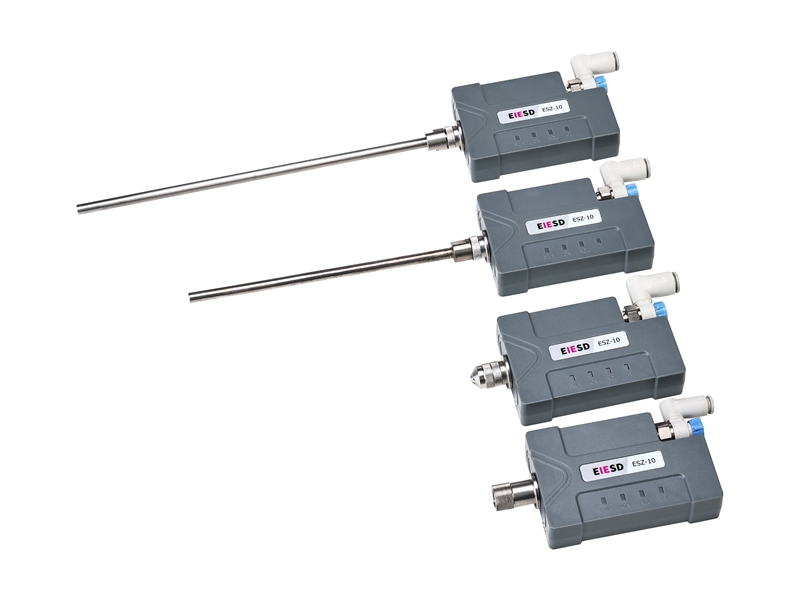
An ionizing nozzle provides concentrated ionized air to a small target area. It is often used where static problems occur at a specific point, such as feeding, separating, picking, or positioning small parts.
Comparison Item | Ionizing Bar | Ionizing Nozzle |
|---|---|---|
Coverage | Wide linear coverage | Small focused area |
Best For | Webs, films, sheets | Local static points |
Air Requirement | Usually no compressed air | Requires compressed air |
Automation Fit | Excellent for full-width lines | Good for point automation |
Cost per Coverage Area | Better for wide materials | Better for small zones |
Use an ionizing bar when the entire material surface needs uniform neutralization.
Use an ionizing nozzle when only one point of the process creates static, such as a feeding corner, robotic pick-up point, or small product transfer area.
An ionizing gun is usually handheld and operated manually. It is commonly used for cleaning dust from parts while neutralizing static at the same time.
Comparison Item | Ionizing Bar | Ionizing Gun |
|---|---|---|
Operation | Automatic / fixed | Manual |
Best For | Production lines | Manual cleaning |
Coverage | Continuous | Intermittent |
Labor Requirement | Low | High |
Suitable for Automation | Yes | No |
Choose an ionizing bar for automated or semi-automated production lines where static must be controlled continuously.
Choose an ionizing gun for manual inspection, cleaning, assembly, or rework stations.
An ionizing air knife combines ionization with high-speed airflow. It can remove static while also blowing away dust, particles, or loose contaminants.
Comparison Item | Ionizing Bar | Ionizing Air Knife |
|---|---|---|
Main Function | Static neutralization | Static removal + dust cleaning |
Air Consumption | Low or none | High |
Noise Level | Lower | Higher |
Best For | Clean flat materials | Dusty or contaminated surfaces |
Operating Cost | Lower | Higher |
Choose an ionizing bar when your main problem is static charge, material sticking, sparks, or web handling instability.
Choose an air knife when dust removal is just as important as static elimination, especially before printing, coating, painting, or packaging.
Passive static eliminators include brushes, copper tinsel, conductive cords, and grounding devices. They do not generate ions actively and usually depend on close contact or induction.
Comparison Item | Ionizing Bar | Passive Static Eliminator |
|---|---|---|
Power Supply | Required | Not required |
Static Removal Effect | Strong and controlled | Limited |
Residual Voltage | Lower | Higher |
Maintenance | Regular but manageable | Simple |
Precision | Higher | Lower |
Best For | Industrial static control | Basic charge reduction |
Passive solutions may help reduce strong static charges, but they usually cannot provide stable, precise, or low-residual static control. For sensitive production environments, active ionization is more reliable.
For flat materials such as films, sheets, labels, paper, and packaging substrates, ionizing bars are usually the most suitable option.
For irregular 3D objects, ionizing blowers or nozzles may work better.
High-speed production lines require faster and more stable ion delivery. Ionizing bars are better suited for continuous moving materials than manual guns or low-speed blowers.
If the static eliminator can be installed close to the material, an ionizing bar can provide strong performance. If the target is far away or the shape is complex, a blower or nozzle may be more suitable.
If the main problem is static charge, choose an ionizing bar.
If the problem includes dust, particles, or surface contamination, consider an ionizing air knife or ionizing air nozzle.
Ionizing bars require a stable mounting position across the material width. If the production area is narrow, a compact ionizing nozzle may be easier to install.
Application Scenario | Recommended Solution |
|---|---|
Plastic film production | Ionizing Bar |
Printing and packaging line | Ionizing Bar |
Slitting and rewinding machine | Ionizing Bar |
Conveyor static control | Ionizing Bar |
Manual dust cleaning | Ionizing Gun |
Bench assembly area | Ionizing Blower |
Small target point | Ionizing Nozzle |
Dust removal before coating | Ionizing Air Knife |
Basic low-cost static reduction | Passive Static Eliminator |

For many industrial production lines, ionizing bars offer the best balance between performance, coverage, automation compatibility, and operating cost.
They are especially valuable when manufacturers need:
Continuous static elimination
Full-width material coverage
Non-contact operation
Stable performance on moving materials
Easy integration with production equipment
Reduced dust attraction and material sticking
Better process consistency
Compared with handheld or air-assisted solutions, an ionizing bar can work automatically once installed correctly. This makes it highly suitable for manufacturers who want to reduce operator intervention and improve production stability.
Low-cost devices may not provide enough ion output, coverage, or stability for industrial use.
Blowers are flexible, but they may not neutralize fast-moving films or webs effectively.
Ionizing guns are useful for manual cleaning but inefficient for automated line control.
Even the right product can perform poorly if it is installed too far away or in the wrong position.
Static causes dust attraction, but if the surface is already contaminated, airflow cleaning may also be required.
There is no single anti-static solution for every production environment. The best choice depends on your material, line speed, process layout, and static control target.
For flat, moving, and continuous materials, an ionizing bar is usually the most efficient and practical solution. For 3D parts, bench work, or manual cleaning, ionizing blowers, nozzles, and guns may be more suitable. For applications requiring both static removal and surface cleaning, an ionizing air knife can be considered.
If your production line handles films, sheets, packaging materials, labels, or web-based substrates, an ionizing bar is usually the most reliable starting point.
The main advantage of an ionizing bar is uniform static elimination across a wide, flat material surface. It is ideal for continuous production lines.
For moving films, sheets, and webs, an ionizing bar is usually better. For workstations or irregular 3D parts, an ionizing blower may be more suitable.
An ionizing bar neutralizes static, which helps reduce dust attraction. If dust must be physically removed, an ionizing air knife or nozzle may be required.
Passive static eliminators can reduce strong static charges, but they are less precise and less stable than active ionizing equipment.
Start by checking your material shape, line speed, working distance, installation space, and whether you need static removal only or static removal plus dust cleaning.
