
Views: 0 Author: Site Editor Publish Time: 2026-05-18 Origin: Site


Plastic materials are widely used across packaging, film converting, printing, electronics, extrusion, and automated manufacturing. However, one persistent challenge remains across nearly all plastic processing lines: static electricity.
Surface charges generated during production can attract dust, cause product contamination, create feeding issues, lead to material sticking, and even interfere with automated equipment performance.
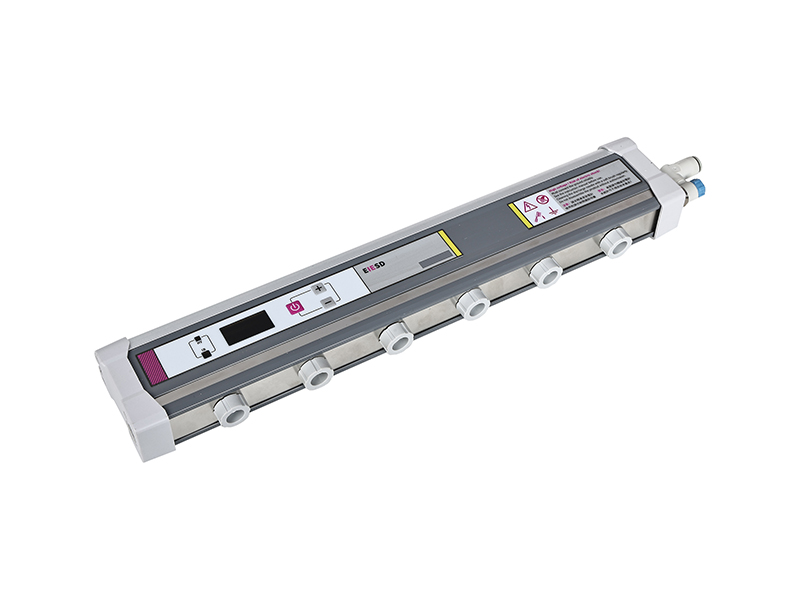
Among industrial anti-static solutions, the Ionizing Bar Rod Type Static Eliminator has become one of the most effective and scalable methods for neutralizing static charge directly at the source.
This guide explains why plastic generates static electricity, how ionizing bars work, and how to choose the right static elimination solution for industrial applications.
Plastic is naturally non-conductive, which means electrical charges cannot easily dissipate after being generated.
Static commonly occurs during:
Film unwinding and rewinding
Plastic sheet conveying
Injection molding release
Extrusion processes
High-speed packaging operations
Friction between rollers and material surfaces
During these processes, electrons transfer between surfaces and accumulate on the plastic surface.
Once charge builds up, manufacturers often encounter:
Dust and particle attraction
Material adhesion
Product appearance defects
Printing quality instability
Conveyor interruptions
Electrical discharge risks
As production speed increases, static problems become more difficult to control using passive methods.
Unlike grounding systems that only work on conductive materials, an ionizing bar actively neutralizes static charges on insulated plastic surfaces.
The operating principle is straightforward.
The ionizing bar creates balanced positive and negative ions through high-voltage discharge technology.
As plastic materials move through the production line, airflow transports ions toward the charged area.
The generated ions combine with accumulated electrical charges.
Positive charges attract negative ions.
Negative charges attract positive ions.
The charge imbalance is eliminated.
Once static is neutralized:
Dust attraction decreases
Material separation improves
Product consistency increases
Production interruptions are reduced
This process occurs continuously during operation without direct contact with the material.
Many manufacturers initially attempt to control static through humidification, grounding, or anti-static additives.
However, these approaches often provide inconsistent performance under industrial conditions.
A rod-type ionizing bar offers several operational advantages.
Feature | Industrial Benefit |
|---|---|
Non-contact neutralization | No damage to plastic surface |
Continuous operation | Stable long-term static control |
Fast response | Suitable for high-speed lines |
Wide coverage | Effective across large material widths |
Compact installation | Easy integration into existing equipment |
Low maintenance | Reduced operating cost |
For automated production environments, ionizing bars provide predictable and repeatable static elimination performance.

Industrial ionizing bars are widely deployed across plastic manufacturing sectors.
PE, PET, BOPP, CPP and multilayer film lines.
Prevent dust adhesion before thermoforming and laminating.
Reduce electrostatic attraction after part release.
Improve surface cleanliness and coating consistency.
Stabilize material feeding and reduce production stoppages.
Protect sensitive components from electrostatic discharge.
Choosing the correct ionizing system depends on production conditions rather than simply selecting the longest bar.
Evaluate these factors first:
Ensure effective ion coverage across the entire product.
Different distances influence neutralization performance.
Higher speeds generally require stronger ion output.
Humidity, airborne particles, and temperature all affect performance.
Confirm compatibility with existing machine layouts and controls.
Selecting based on application conditions typically delivers better long-term static control and lower maintenance cost.
To maintain stable ionization performance:
Install at the recommended working distance
Ensure proper grounding
Clean emitter points regularly
Inspect ion balance periodically
Avoid contamination buildup around emitters
Routine maintenance helps preserve consistent static elimination efficiency.
Static electricity remains one of the most common hidden causes of contamination, instability, and production inefficiency in plastic processing.
While temporary methods may reduce symptoms, an industrial Ionizing Bar Rod Type Static Eliminator provides continuous and controlled static neutralization directly during production.
For manufacturers seeking cleaner surfaces, more stable throughput, and improved product consistency, integrating an ionizing bar into the production line is often the most effective long-term solution.
Can ionizing bars permanently remove static?
No. They continuously neutralize static while production is running.
Does an ionizing bar damage plastic surfaces?
No. Static elimination occurs without physical contact.
Can ionizing bars work on transparent films?
Yes. They are suitable for most plastic film and sheet materials.
Do ionizing bars require compressed air?
This depends on the model configuration and installation environment.
